ResourcesTeamPricingContact sales

Starbucks announced last week that it is closing approximately 250 stores across North America as part of its ongoing “Back to Starbucks” strategy. The company says it identified locations where it does not believe it can consistently deliver the experience it wants for customers and employees, or where it does not see a path to acceptable financial performance. Ok. Whatever.
Starbucks expects approximately $300 million in restructuring charges, including approximately $200 million in cash charges primarily related to lease exits and employee separation benefits.
This is not an academic exercise for me.
I have negotiated multiple lease terminations and buyouts over the years. I have negotiated multiple Starbucks leases. Over the past year, I have also had clients who built new Starbucks stores from the ground up, completed their obligations under the lease, and attempted to hand Starbucks the keys, only to have Starbucks refuse to take possession. Wonderful.
Now I have clients who own Starbucks properties included in this latest round of closures. They need help.
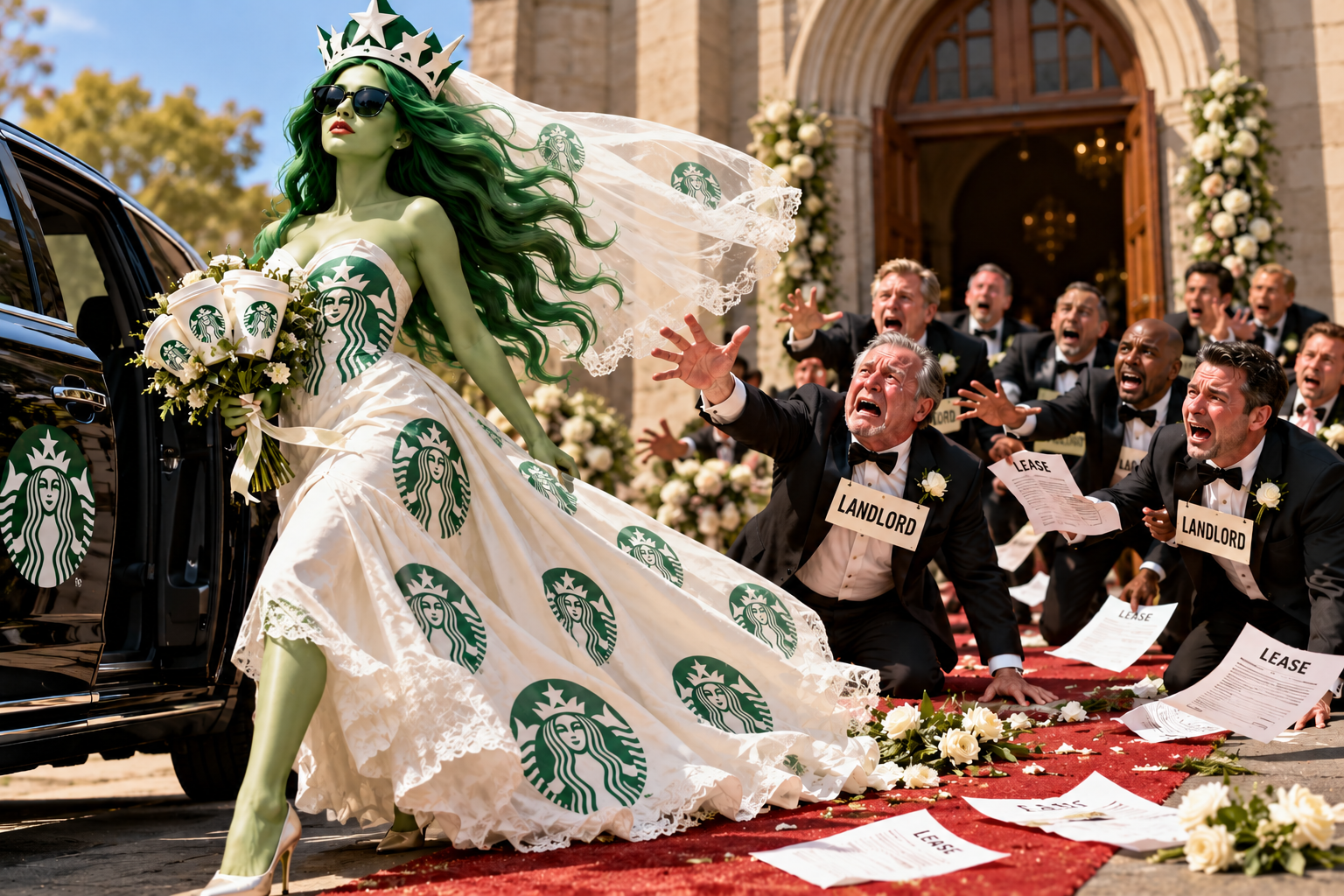
Let me say this: Make no mistake about it, Starbucks will leave you at the altar 100 times out of 100. Starbucks is NOT a credit tenant. Starbucks does not deserve your consideration as an investable tenant. There are many other operators that would never pull this move on landlords. Dutch Bros, 7 Brew, Black Rock Coffee, and Better Buzz come to mind. In fact, the brokers for all four of these tenants have already reached out to my clients who have sites on the closure list. Kudos to those guys. Rent is $300,000 per year with no TI. Yes or no?
I digress.
I decided to dig into the data.
I took the September closure list and ran the locations through DealGround. I found 58 of these properties with OMs, including 51 single-tenant Starbucks properties and seven multi-tenant centers. Of the single-tenant properties, 50 had enough information to determine the remaining lease term.
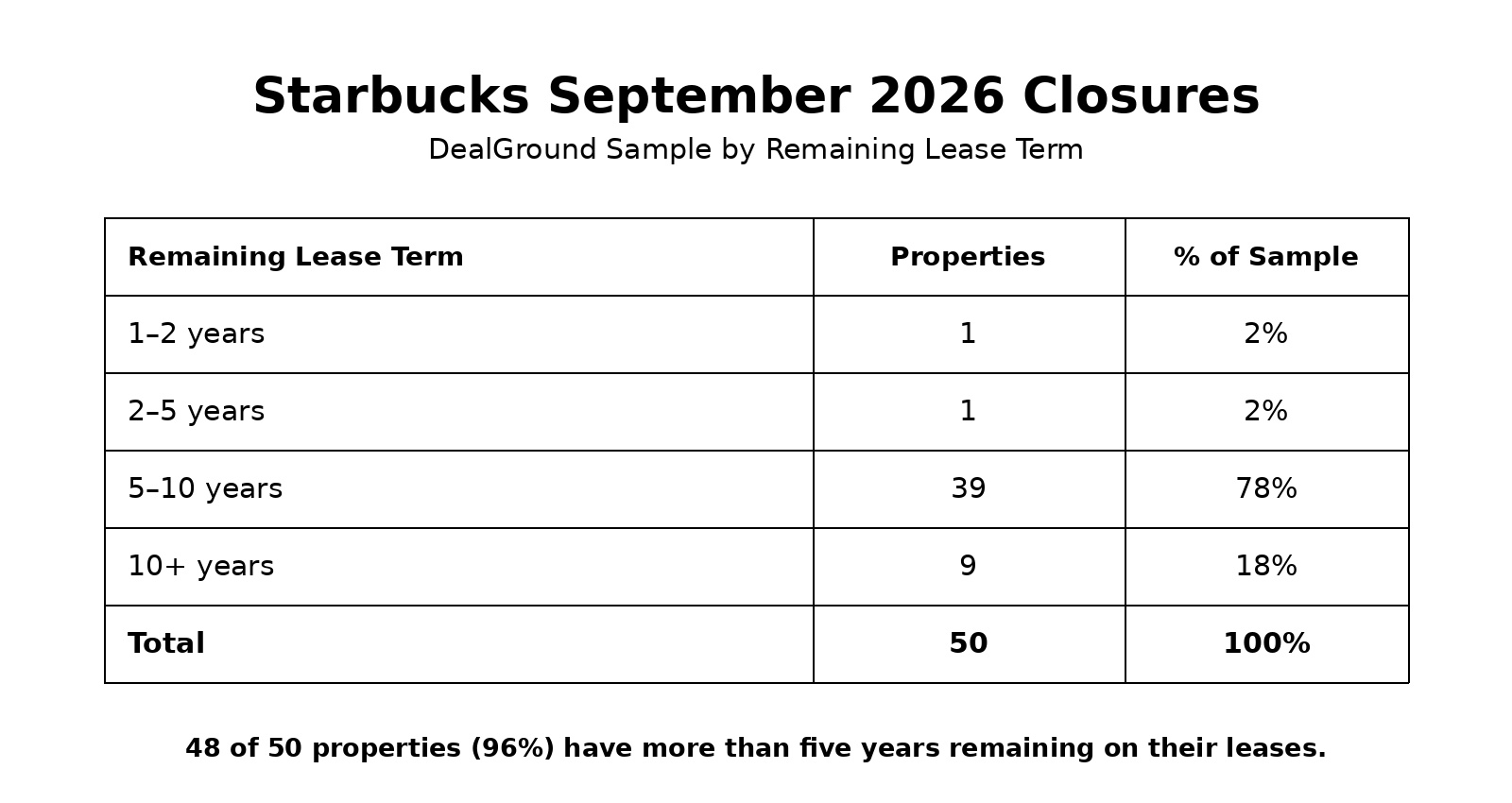
Here is what I found:
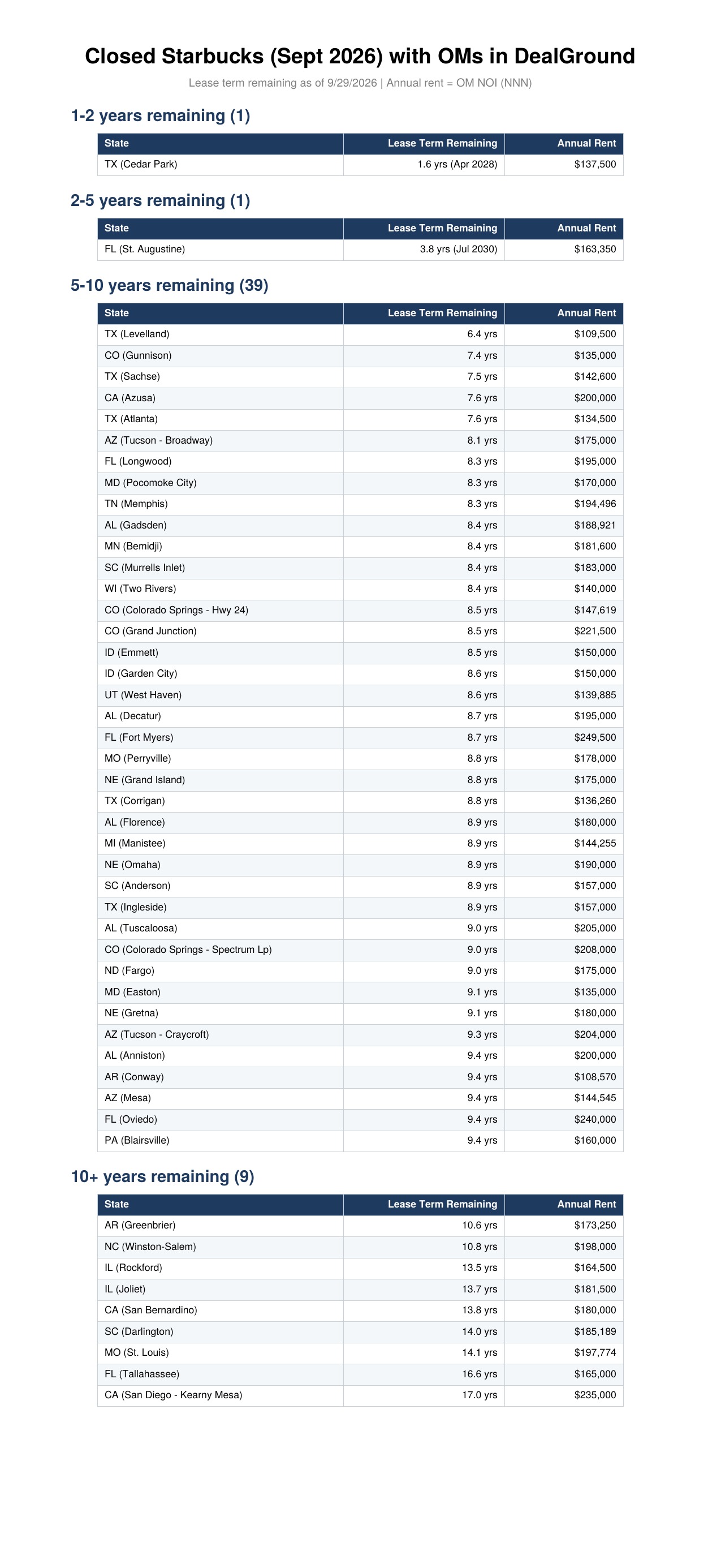
A more detailed breakdown of the data gathered from DealGround appears at the end of this article.
Of the 50 properties for which I could determine the lease expiration, 48 have more than five years remaining on their leases. Thirty-nine have between five and ten years remaining and nine have more than ten years remaining.
These are not primarily old stores where Starbucks is simply allowing the lease to expire. Several are relatively new drive-through stores built in 2024 and 2025 and subsequently sold to investors with new long-term Starbucks leases.
Many have significant term remaining. The Kearny Mesa location in San Diego has approximately 17 years left. Tallahassee has 16.6 years. St. Louis has 14.1 years. Darlington, South Carolina has 14 years. San Bernardino has 13.8 years. I have information on several others that were never on market and can personally validate these findings as directionally accurate.
That is what makes your lease so important.
I recently reviewed leases for two of the Starbucks stores included in this round of closures. To say that Starbucks plans for future default would be a gross understatement.
The leases specifically state that Starbucks has no continuous operating covenant. Fine. No big deal. Starbucks can close the store. If Starbucks remains closed for the period specified in the lease, the landlord has a right to recapture the property, but Starbucks has no obligation to continue operating. All good. They are still obligated under the lease.
Then you get to the default provision. This provision governs landlord remedies.
The leases provide that Starbucks will not be liable for consequential damages or for lost Base Rent and Annual Additional Rent beyond a specified period, two years in one lease and four years in the other.
This provision is unacceptable. Starbucks knows what they are doing. They know full well that they may leave any particular landlord at the altar at some point in the future.
Starbucks has a long history of periodically closing stores en masse. It has done this under different management teams and for different reasons. It announced roughly 900 closures during the financial crisis, another 800 or so during the COVID-era restructuring, and more than 600 in 2025.
That is the history. These are the facts.
Starbucks closes stores. Sometimes it closes them with significant lease term remaining. They DO NOT CARE. The DealGround data shows this is exactly what is happening today.
This means that your Starbucks lease is worthless. I have said this already but I will say it again: Starbucks intentionally negotiates provisions in their lease that cap their default exposure because they know there is a reasonable probability that they will leave you at the altar at some point in the future. Fact.
We cannot know what Starbucks’ lawyers were thinking when the provision was originally drafted. We can actually, but they will never admit it. Sophisticated tenants do not negotiate default protections accidentally. If a tenant asks you to limit its financial obligations if it defaults, there is a reason it wants that language. NEVER agree to it. Never.
There is also a very recent example involving Starbucks that demonstrates exactly why landlords should care.
Earlier this year, a federal court in Virginia considered a dispute involving another Starbucks lease.
Starbucks argued that substantially similar lease language limited its liability to two years of base rent. The court declined to accept Starbucks’ interpretation at the motion-to-dismiss stage because other remedies contained in that particular lease could potentially remain available. The ultimate scope of damages was not decided at that stage.
The important point is not who ultimately wins the case.
Starbucks made the argument.
This wasn't some obscure paragraph buried in the lease that nobody expected would ever matter. Starbucks pointed to the limitation and argued that its liability should be capped.
Landlords should pay attention to that.
There is a much broader lesson here that applies to every landlord negotiating a lease, not just landlords dealing with Starbucks.
Never agree to a provision that limits a tenant’s obligations if the tenant defaults.
The entire purpose of a long-term lease is that both sides are making a long-term contractual commitment. The landlord is making a long-term commitment to the tenant, often spending significant money constructing or improving the building, and in many cases financing or selling the property based on the income stream created by that lease.
I have clients who have spent the money, built the Starbucks building, satisfied the requirements they believed were necessary to deliver the property, and then tried to hand Starbucks the keys, only to have Starbucks refuse to take possession.
When you have seen this happen in the real world, provisions limiting a tenant's liability upon default take on an entirely different significance. A four-alarm fire, if you will.
If the tenant signs a ten-year lease and defaults in year three, why should the landlord have agreed in advance to limit the tenant's exposure to two years? They shouldn’t.
If a sophisticated tenant asks for that protection, don't treat it as standard legal language. They are negotiating today for what happens if they don't honor the deal tomorrow.
That should tell you something.
If a tenant needs flexibility to leave early, negotiate that right explicitly and determine the economics when the lease is signed. That is completely different from entering into a long-term lease and simultaneously limiting the tenant's liability if it defaults.
I would never agree to the latter.
The DealGround data makes this point much more tangible.
For years, investors have paid aggressive cap rates for newly constructed Starbucks properties because they believed they were buying long-term corporate Starbucks income.
In many cases, the developer built the property specifically for Starbucks, signed a new long-term lease, and then sold the property to a passive investor based largely on Starbucks’ credit and remaining lease term.
Now look at the properties Starbucks is closing.
Thirty-nine of the 50 properties in our DealGround sample have between five and ten years remaining. Nine have more than ten years remaining.
The lesson is pretty simple. Never trust Starbucks.
A landlord may have eight years remaining on a Starbucks lease. Starbucks may have every right to stop operating the store. Depending on the language in the lease and the remedy the landlord pursues, there may be a dispute over how much of those remaining eight years Starbucks is actually obligated to pay following a default.
This is something you want to understand before you build or buy the property, not after Starbucks calls to tell you the store is closing.
This is where the issue becomes very practical for me because I have clients on this closure list asking me that exact question.
If I am negotiating one of these buyouts, I am not starting with Starbucks' proposed termination payment.
I am starting with the lease.
The first step is having competent real estate counsel analyze the default and remedies provisions. Determine whether the lease contains a limitation on damages and, more importantly, exactly how that limitation interacts with the landlord's other remedies under the lease.
That distinction is everything.
In the leases I reviewed, the landlord has a remedy allowing the lease to remain in effect after a tenant breach or abandonment and allowing the landlord to recover rent as it becomes due. There is a legitimate legal question about how a contractual cap on damages interacts with that remedy.
I would also be extremely careful about exercising a recapture right simply because Starbucks stopped operating. Getting the property back may ultimately be the right decision, but DO NOT send a termination or recapture notice until you understand exactly what rights and future rent claims you could be giving up.
Then calculate the entire remaining contractual obligation. Base rent, increases, additional rent, taxes, insurance and every other monetary obligation under the lease.
After that, figure out what the real estate is actually worth without Starbucks.
What is market rent? What would another drive-through user pay? How long will it take to re-lease the property? What will TI and leasing commissions cost? Is Starbucks paying above or below market?
If Starbucks is paying $180,000 and you can replace them with another user at $225,000, getting the property back could be a great outcome. Maybe.
If Starbucks is paying $225,000, replacement rent is $150,000, and it will take 18 months and substantial TI to get another tenant open, the economics are completely different.
You need to know those numbers before you negotiate.
Make Starbucks make the first proposal. Starbucks has already publicly disclosed that it expects significant cash costs associated with these lease exits.
Don't negotiate against yourself.
Starbucks is dealing with approximately 250 closures.
Any individual landlord is dealing with one.
Starbucks knows what is in its other leases. It knows which landlords agreed to limitations on remedies. It knows what it is offering other owners. It knows what settlements are being accepted. It knows which properties create the greatest exposure.
The individual landlord knows none of this. Tell them NOTHING. Do not tell them which tenants you have at the table. Do not tell them what you think replacement rent is. Starbucks isn't telling you why it is closing the store, so why would you tell Starbucks anything about why you are holding your position? The only thing you tell them is your number. No justification necessary. Period.
This is exactly the type of information gap we built DealGround to help solve.
I was able to take the closure list, identify 58 properties where we had previously captured Offering Memorandums, and pull lease information on 51 single-tenant Starbucks properties. That allowed us to see something an owner looking at one property could never see: 96% of the locations in our sample with known lease expirations still had more than five years remaining.
For a broker advising one of these landlords, that information is invaluable.
I want to know how much term remains on the other closing stores. I want to know the rents. I want the original Offering Memorandums. I want to know when the properties traded and what investors paid. I want to know what comparable Starbucks properties are currently being marketed. I want to know who owns the other affected locations.
DealGround gives me a head start on all of it.
It also creates a pretty obvious opportunity for brokers.
There are landlords across the country who recently learned that the Starbucks they thought they had for another five, eight, ten or even 17 years is closing.
Those owners are going to need advice.
They need someone who understands the lease, the underlying real estate, replacement rents, potential replacement tenants and the economics of a buyout.
More importantly, they need someone who knows how to negotiate.
I've negotiated Starbucks leases. I've negotiated lease terminations and buyouts. I'm now giving advice to clients as to how to weather this existing storm.
That doesn't mean every client gets everything they want. That's not how negotiations work. I don't walk into a negotiation without understanding the contract, the economics, the other side's alternatives, and my client's leverage. I don't lose negotiations.
Information is leverage.
That's exactly why the DealGround data matters.
Anyone negotiating a new Starbucks lease, or frankly any long-term corporate lease, should learn something from this.
Spend as much time understanding the default provisions as you spend negotiating the rent.
I would never voluntarily limit a tenant's obligations following a default. If a sophisticated tenant insists on language protecting itself from the economic consequences of breaking a long-term lease, assume the provision is there because the tenant expects it could matter someday.
The landlord is making a long-term commitment. The tenant should be making one too.
The DealGround data shows why this matters.
Starbucks is closing stores today with five, eight, ten and, in at least one case in our dataset, approximately 17 years remaining on their leases.
A long-term lease is valuable only to the extent the lease protects you when things don't go according to plan.
Before you sign a lease, read the default provisions. Before you terminate a lease, understand your remedies. Before you negotiate a buyout, understand your leverage.