ResourcesTeamPricingContact sales

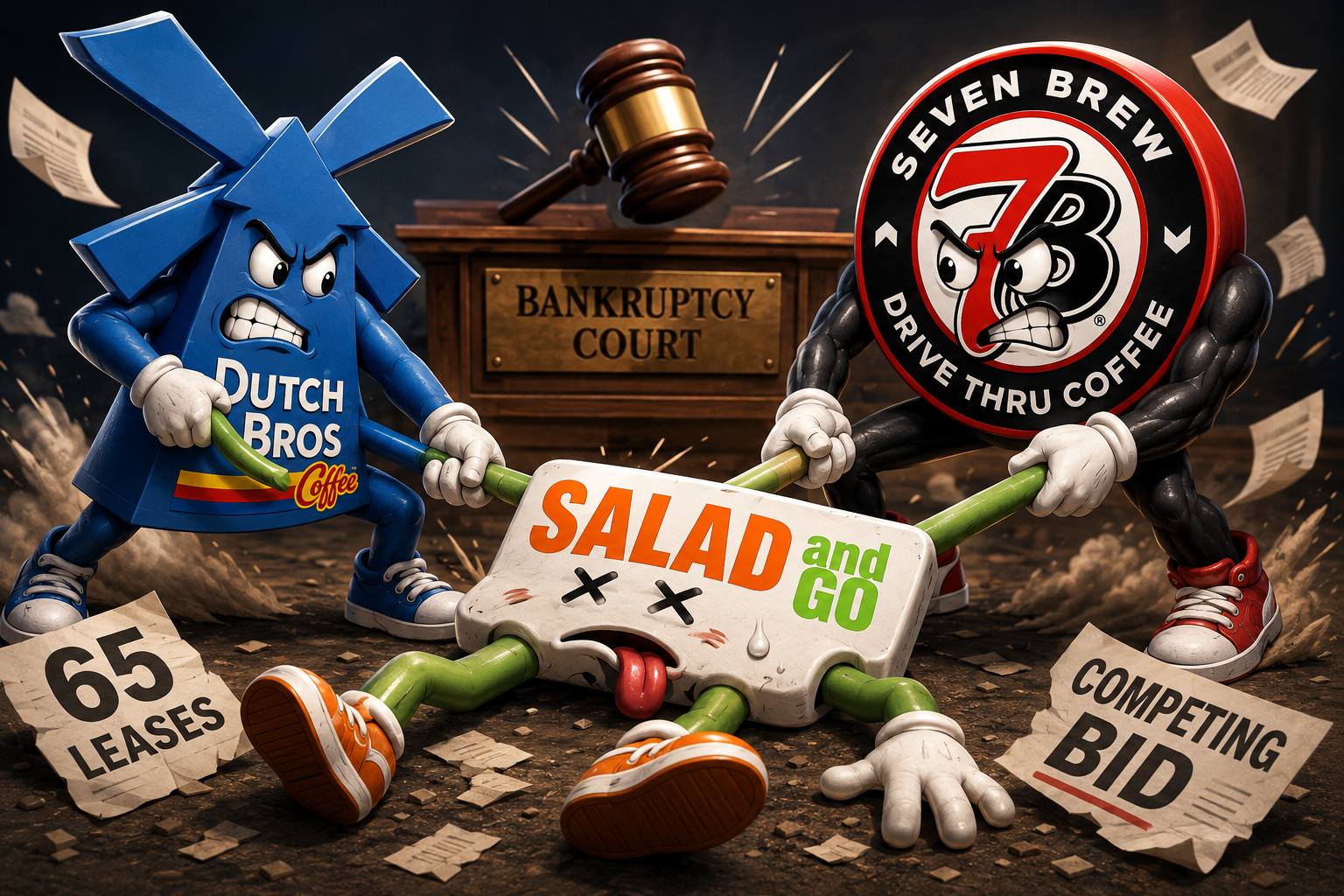
Everyone seems to be talking about the Salad and Go bankruptcy saga. All the usual suspects have weighed in. The media initially reported that Dutch Bros had agreed to acquire at least 51 shuttered Salad and Go leases for approximately $105 million, with subsequent reports putting the number of sites as high as 65 (or approximately $2.05M per site for 51 sites). A couple of days ago, news broke that 7 Brew has petitioned the bankruptcy court in Houston (arguably the current corporate bankruptcy capital of the U.S.) claiming they have a superior bid that will lead to greater financial recovery and therefore the court should open the process up to a competitive auction.
I wanted to let the dust settle a bit and share some thoughts on how I think this could play out and what I see happening.
This has the potential to become one of the more interesting Chapter 11 real estate fights I've seen in the retail space because the rescue value has nothing to do with the operating business. The value on offer is completely based on a portfolio of already-entitled, drive-thru real estate sites. There is no question that Dutch Bros and 7 Brew are players 2 and 3 in the drive-thru beverage game. The Green Goddess still reigns supreme.
I have a decent amount of experience negotiating with tenants going through bankruptcy proceedings on behalf of clients (luckily, never on my own account). To the uninitiated, the primary mandate of the bankruptcy court is to obtain maximum recovery for creditors (lenders, bondholders, vendors, etc.). For prepetition rent and lease rejection damages, landlords generally find themselves in the pool of unsecured creditors, near the bottom of the bankruptcy waterfall.
Prior to this filing, Salad and Go had already shuttered all of its locations in Texas and Oklahoma. Those landlords would ordinarily have little reason for optimism, although reports indicate that some Texas and Oklahoma leases may also be included in the Dutch Bros transaction. For the sites in Texas and Oklahoma that are not ultimately assumed, the landlords should expect the leases to be rejected. As a practical matter, I would expect their recovery to be zero.
For starters, I looked at the Salad and Go sites in Arizona and Nevada to understand the real estate characteristics / fundamentals, the current rents under the existing leases, and remaining lease terms to get a sense of what Dutch Bros and 7 Brew are getting into. In my DealGround database, I can see all 65 Salad and Go locations in Arizona and Nevada. Annual rents range from approximately $94,000 to $209,000 per year, with an average of approximately $120,000 per year. The buildings range in size from approximately 650 to 1,000 square feet. Parcel sizes range from just over 16,000 square feet to over an acre. Almost all of the existing leases have over 10 years of primary term remaining, with the vast majority having closer to 13 to 14 years of primary term remaining (plus renewal options). Those are the indisputable metrics.
From the perspective of the Salad and Go landlords, they should be rooting for the full assumption of their leases by Dutch Bros and opposed to 7 Brew. Dutch Bros no longer franchises new locations, so its assumed sites would be company-operated. An assumption by 7 Brew will almost certainly mean leases assigned to franchisees pursuant to existing territorial rights. 7 Brew certainly has strong franchise operators (Flynn Group comes to mind). Unfortunately for landlords, they don't get to simply choose Dutch Bros because they prefer the credit. While the proposed assignee must provide adequate assurance of future performance, landlord preference does not control the assignment process. The court's focus is maximizing value for the estate and the probability of creditor recovery. The court is not concerned with whether Dutch Bros credit will result in a lower cap rate and higher resale value for the landlord.
The average Dutch Bros footprint is slightly larger than the average 7 Brew, but not by much. I don’t really see an issue with either operator creating a “secondary prototype” to shoehorn into these Salad and Go sites, although I’d argue 7 Brew can make them work more easily than Dutch Bros can. If it were a single site, I’d say it is unlikely either operator would make an exception to their existing prototype, but for 65 sites at once, both will happily make the exception. It’s not every day an operator gets to flip the switch on 65 sites at once.
I don’t think there is much difference in conversion costs for either operator. I’d assume either tenant will end up at just over $2.3M to $2.4M per site after all is said and done. A basis in this range seems on par or maybe just a touch higher than each operator’s out-of-pocket costs per unit to date (for ground-up sites). Where I see the primary economic benefit is in the existing rents.
It is highly unlikely that either Dutch Bros or 7 Brew could amass 65 new sites in Arizona and Nevada today at average rents of just $120,000 per year. Given the long duration of these existing leases, that represents significant savings over the next 15 to 25 years.
Usually, in a tenant bankruptcy proceeding, the tenant (either the existing tenant in an attempted bankruptcy restructuring or the pursuing tenant in a bankruptcy liquidation and assignment) hires a firm to call all of the landlords in an attempt to renegotiate the lease terms. They will usually ask for lower rent, free rent for some period of time, an extension of the lease term, other improved terms, or any combination thereof. My advice is to always say no. Wait until you are the last one standing. I can see two sides to this coin in the Salad and Go saga:
As always, the leverage held by each landlord and final outcome will come down to the quality of their real estate, the fundamentals of their lease as compared to market, and each individual landlord’s ability to negotiate. Salad and Go Landlord Union, anyone?
One thing is for sure, this process will not be quick. There will almost certainly be extensions granted by the court. Even if landlords end up with their leases being assumed, they should not expect any recovery for the loss of rents in the interim period from the date Salad and Go vacated and stopped paying rent to the date upon which the new tenant takes occupancy. Recovery for this shortfall, if any, would come from the bankruptcy estate based on whatever claim the landlord properly files with the court.
So how did these landlords end up in this position? The answer has nothing to do with the fact that they bought real estate occupied by a third-rate tenant. It has everything to do with the fact that they bought real estate with substandard fundamentals. How many viable tenants seek out 800 square foot drive-thru buildings on less than 20,000 square feet of land? Not many. Well, there are actually several around now but do you really want to own them? Would you bet your income on them? These are the here today, gone tomorrow concepts. Don’t even get me started on Swig. A few will emerge and operate strong businesses. Do we really think that there will be 6 or 7 new Starbucks stories in the beverage business? I would bet no.
Better yet, I would suggest not betting at all. I suggest buying the best real estate you can find at all times. If you can get a great tenant at the same time, all the better. I’ll take the single-location franchisee at Main and Main with 50,000 people in a one-mile radius and 60,000 cars at the intersection over the 300-location tenant with 50,000 people in a ten-mile radius at a 25,000 car per day intersection every single day of the week.
Tenants come and go. The land is the asset. Ask yourself this question: When your building goes vacant, do you want to have to pick up the phone and call tenants or do you want tenants to pick up the phone and call you? I can tell you which scenario will yield the better outcome. If Dutch Bros and 7 Brew already had significant penetration in these Arizona and Nevada markets, nearly all of these Salad and Go landlords would be dead in the water. That’s a fact.
One last thought, if your lease is assumed by either Dutch Bros or 7 Brew, you should sell immediately. This is your chance to get out and live to fight another day. Holding because you think you now have a great tenant is what got you here in the first place. You got lucky. Time to move on.