ResourcesTeamPricingContact sales


Over the past few weeks, QSR Magazine has published several in-depth pieces on restaurant brands with clear plans for growth in 2026 and beyond.
Three tenants stood out to me right away:
These companies all had disciplined operations, improving unit economics, and a very intentional approach to expansion.
Whenever I read about a tenant signaling growth like that, I tend to do one thing:
I open DealGround to see how that growth shows up geographically and where the gaps start to appear. Once you put the data and the maps side-by-side, the opportunity becomes much easier to understand.
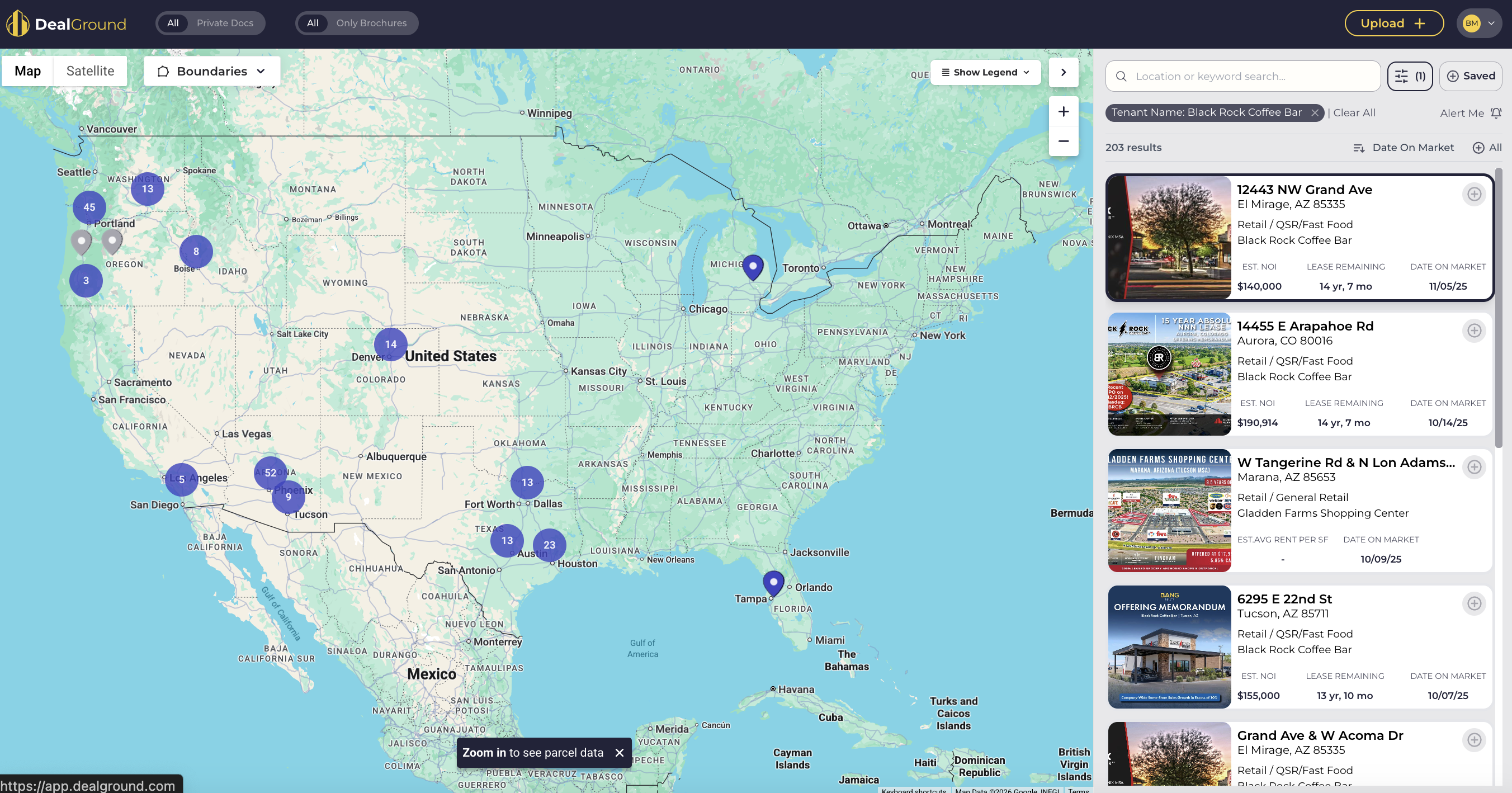
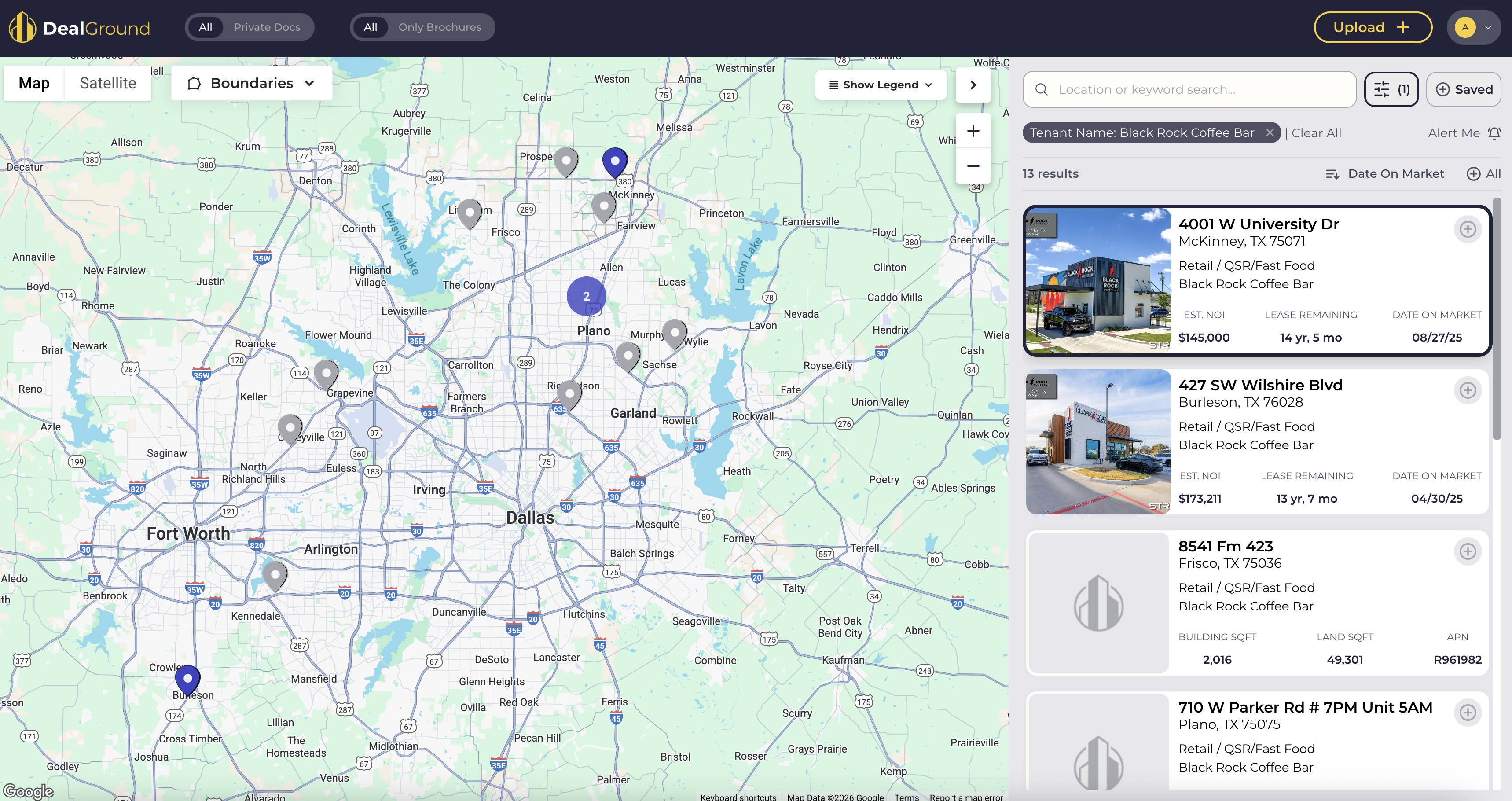
Black Rock Coffee Bar enters 2026 with approximately 200 locations across seven states:
Arizona, California, Colorado, Idaho, Oregon, Texas, and Washington
The company has publicly stated a long-term goal of reaching 1,000 stores by 2035, growing at roughly 20% per year. But what’s notable isn’t just the ambition, it's the structure behind it.
Black Rock Coffee Bar has been explicit about a concentric-circle expansion strategy:
The operating data supports that approach:
This is a brand focused on repeat visits and operational consistency, two things that matter a lot when it comes to site selection.
From a real estate perspective, the opportunity isn’t guessing which new state comes next.
It’s identifying:
These are logical next moves and they show up very clearly on a map.
These are logical next moves and they show up very clearly on a map.
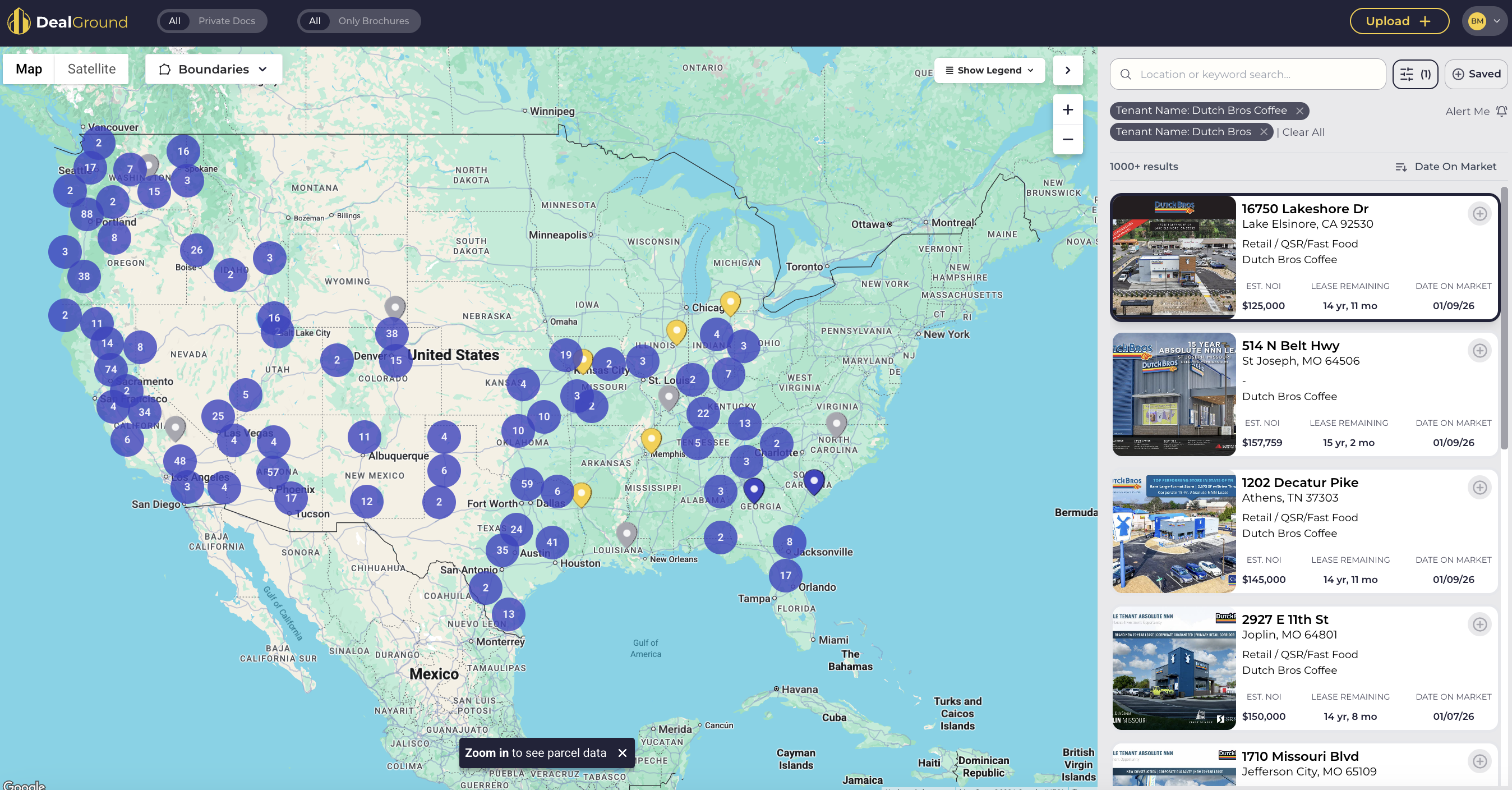
Dutch Bros is already operating at national scale.
As of late 2025, the brand has:
Performance data explains why growth is accelerating:
Dutch Bros has also shown discipline by refining its pipeline and removing sites that don’t meet updated performance thresholds and prioritizing locations that support long-term economics.
On a map, Dutch Bros expansion tends to reveal:
Those gaps often point to where expansion is coming next.
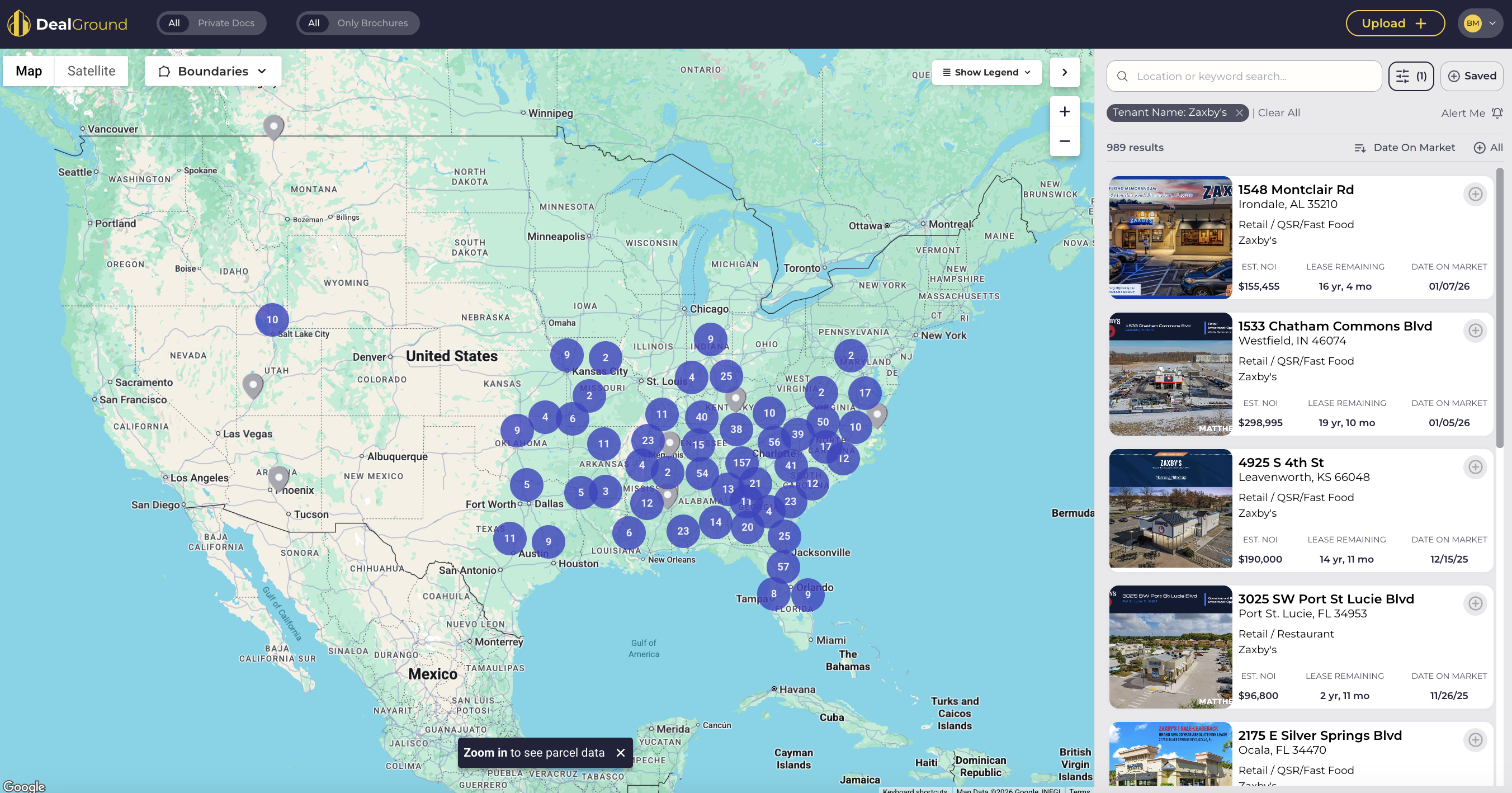
Zaxbys’ growth story is quieter, but instructive.
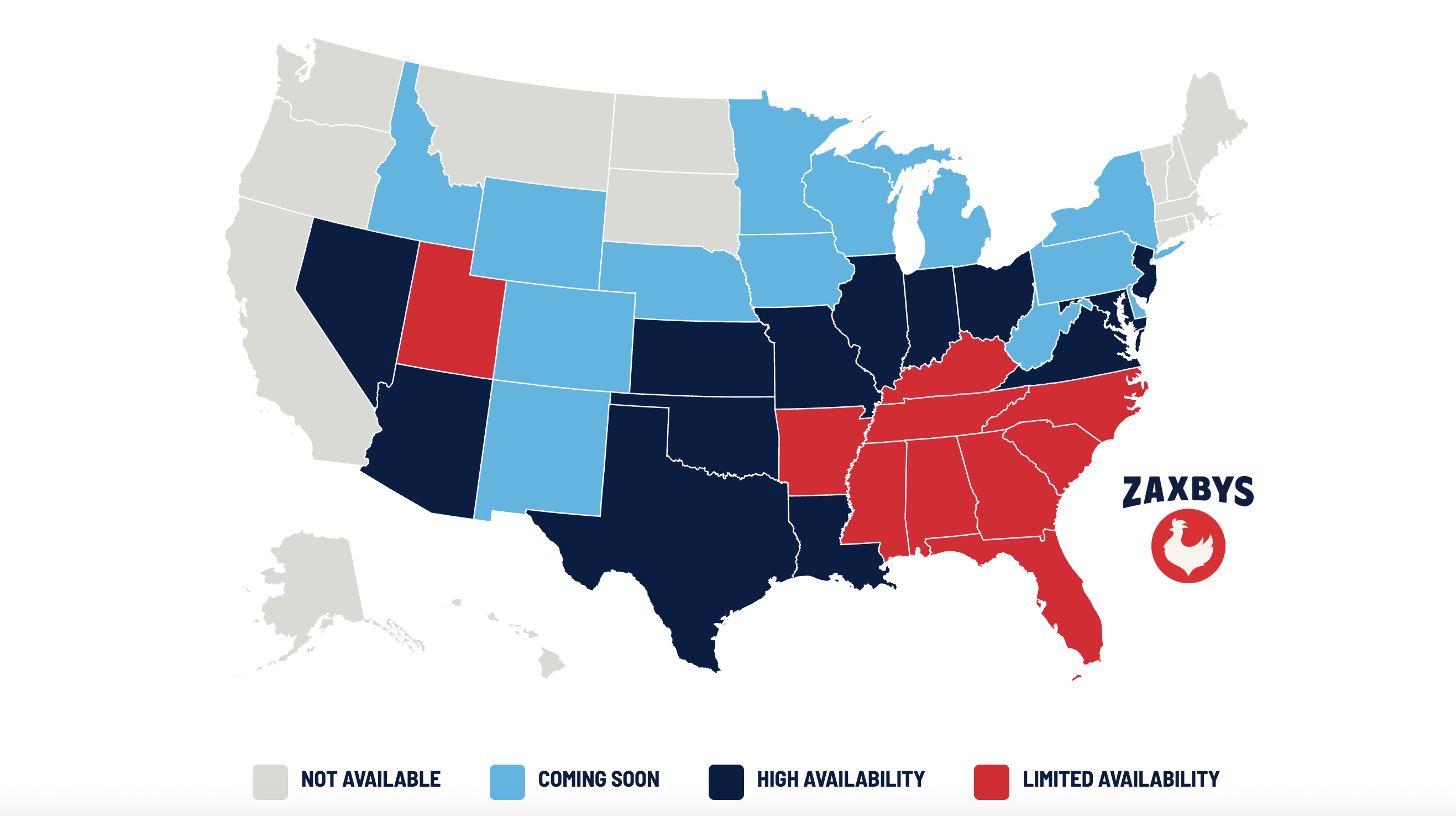
Today, the brand operates 925+ locations, historically concentrated in the Southeast. After several years of operational, digital, and cost-structure improvements, Zaxby’s is positioned to resume steady expansion.
The biggest change is the real estate strategy.
Zaxby’s now supports:
As a result, the brand is now focused on adding roughly 50+ new locations per year, with a realistic path to crossing 1,000+ total units very quickly.
One clear signal: Zaxby’s recently signed its first franchisee in New York, using an inline model to enter dense urban markets that were previously out of reach.
Zaxbys’ next phase of growth is likely to appear:
Those markets often look quiet,until they’re not.
The following images show Zaxby's current national footprint, their expansion plans, and the massive opportunity presented in the Dallas / Ft. Worth market - all pulled up in seconds using DealGround.
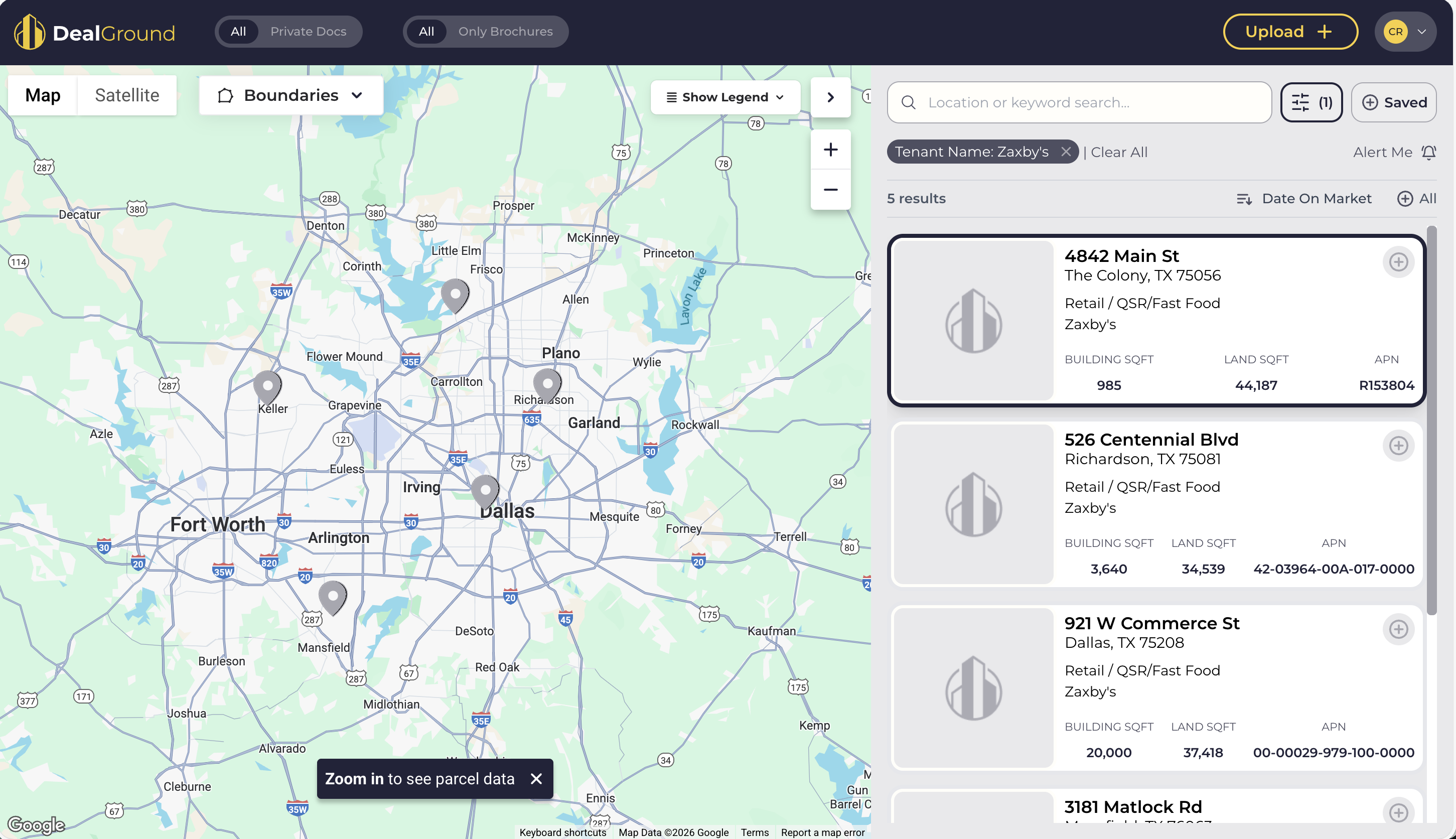
This is where the process becomes actionable.
Inside DealGround, the workflow is straightforward:
Using DealGround, you could search for QSR sites (or any other single-tenant asset) with short remaining lease terms, create a target list, and send that list out for ownership researrch (to obtain name, phone, email) in a matter of moments, regardless of whether that list is 5 properties or 500 properties. That's the power of the continuity of information provided by the DealGround platform.
What used to take days of manual research now happens in minutes.
Black Rock Coffee Bar is scaling carefully with public-market discipline.
Dutch Bros is opening more stores than ever, while tightening site selection.
Zaxby’s has reworked its real estate model to access entirely new markets.
None of this is abstract.
It’s visible. It’s measurable. And it’s already happening.
The advantage isn’t predicting the future. It is seeing opportunity clearly, quickly, and acting before it becomes obvious to everyone else.
That’s the edge DealGround is built to deliver for brokers and investors.