ResourcesTeamPricingContact sales


Published May 12, 2026 · By the DealGround team · ~7 min read
Today, most CRE professionals use AI regularly, but they are only beginning to discover its real value.
Brokers are already using it to summarize information, draft materials, speed up research, and work through the repetitive tasks that have long slowed down dealmaking. As the stakes get higher, the industry draws a much sharper boundary. Critical decisions are not being offloaded to AI. Brokers and investors have made it this far with their existing toolboxes and they aren’t willing to let that go…yet.
That is the central tension captured in the new CRE Industry Pulse Check, co-authored by DealGround and First American Data & Analytics. Based on a survey of 255 CRE professionals across brokerage, capital markets, development, and asset management, the report found that 66% of CRE professionals use AI weekly or daily, yet only 5% trust it enough to rely on it.
That trust gap is the story.
From where we sit – inside the workflows of individual brokers and many of the country’s largest CRE brokerage firms – CRE professionals are not rejecting AI. They are pressure-testing it: figuring out where it saves time and where it can uncover new opportunities.This distinction matters. The early advantage is no longer simply using AI. Two-thirds of CRE professionals report using AI regularly. The advantage belongs to the firms that can move AI from a helpful productivity layer into the trusted workflows, data, and tools brokers are willing to rely on when a deal is on the line. That window is open now. It will not stay open long.
The full report covers a lot of ground, but these are the three findings we keep coming back to:
The market's top priorities for AI's next phase: automating manual transaction and closing processes (33%) and delivering reliable comps in thin or opaque markets (25%).

The question of whether CRE professionals use AI is settled. The question of why so few trust it for real decisions has a cleaner answer than most expect: it's not cost, and it's not skepticism about AI. It's that the underlying data most AI tools rely on isn't structured, current, or verifiable enough to stake a deal on.
Read those together and the question shifts. It's not "will CRE professionals use AI?" – they already are. It's where AI earns trust in the parts of the deal where being wrong can cost you a client.
The survey data paints a clear picture of where AI has landed in CRE workflows – and where it hasn't. The most common use cases today are:

The pattern is clear: AI is earning its place in the lower-risk, higher-volume parts of the workflow. The closer a task gets to a deal decision, the less willing brokers are to let AI drive.
The survey doesn't tell us what separates the 5% who trust AI for deal decisions from the other 95%. But from our vantage point, it's rarely about technology. The brokers moving AI closer to influencing important decisions are working with better data and more verifiable workflows. The gap isn't capability. It's trust and execution. Brokers know exactly what they want AI to do, but they won't stake a client relationship on outputs they can't stand behind.
"The number that stands out most to me is that only 5% of CRE professionals are using AI for deal sourcing and prospecting today," said Dan Mosher, Co-Founder and CEO of DealGround. "That's the part of the business that actually generates income. That's where we're focused at DealGround — building the solution that addresses the highest-value part of the chain. In less than a year since launch, teams from the top 15 brokerage firms in the country have used DealGround to surface deals they wouldn't have seen otherwise. That's what we do better than anyone else.”

DealGround co-authored the CRE Industry Pulse Check with First American Data & Analytics – a leading national provider of property data, title intelligence, and risk management solutions, and a division of First American Financial Corporation (NYSE: FAF). The survey reached 255 qualified CRE professionals across brokerage, lending and capital markets, development, and asset management, fielded March 31 through April 8, 2026. What follows is DealGround's editorial interpretation, and what the findings mean for the brokers we work with every day.
You can read the full press release and download the report here: http://report.dealground.com/cre-pulse-check-report-may-2026
The findings capture a moment in time for brokers in our industry that is more interesting than the headline numbers suggest.
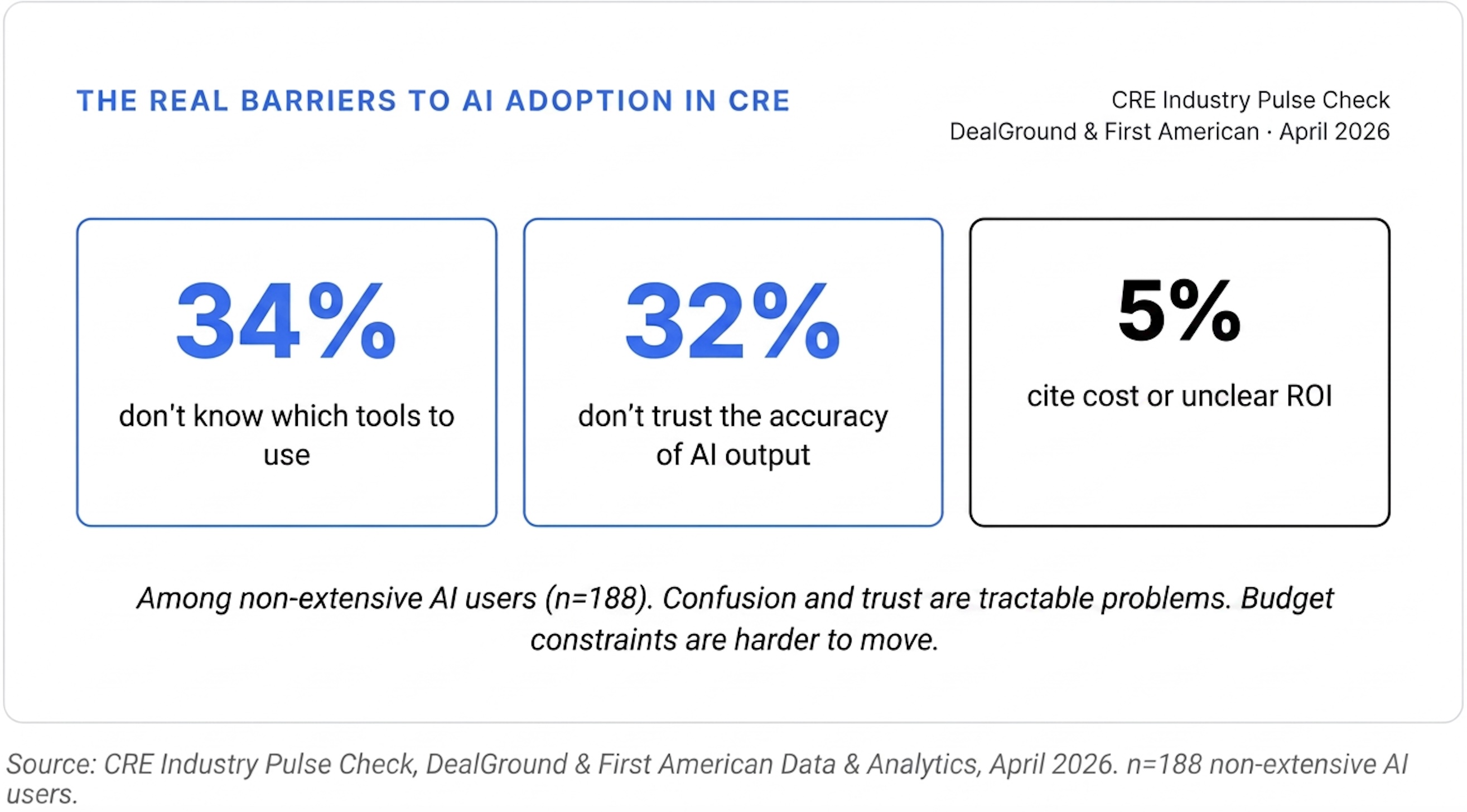
One of the more counterintuitive findings in the study: only 5% of CRE professionals surveyed cite cost or unclear ROI as the main reason they haven't adopted AI more aggressively. The actual blockers are "I don't know which tools to use" (34%) and "I don't trust the output" (32%) among respondents not already using AI extensively.
We find this encouraging; confusion and trust are tractable problems. Budget constraints are harder to move. From our vantage point, the brokers and firms moving fastest aren’t buying more tools. They are getting sharper about which data they can actually act on, and pushing AI into workflows where the underlying information is current, reliable, and structured around how deals actually get done.
When respondents named the AI capabilities they most want next, two answers led every other category:
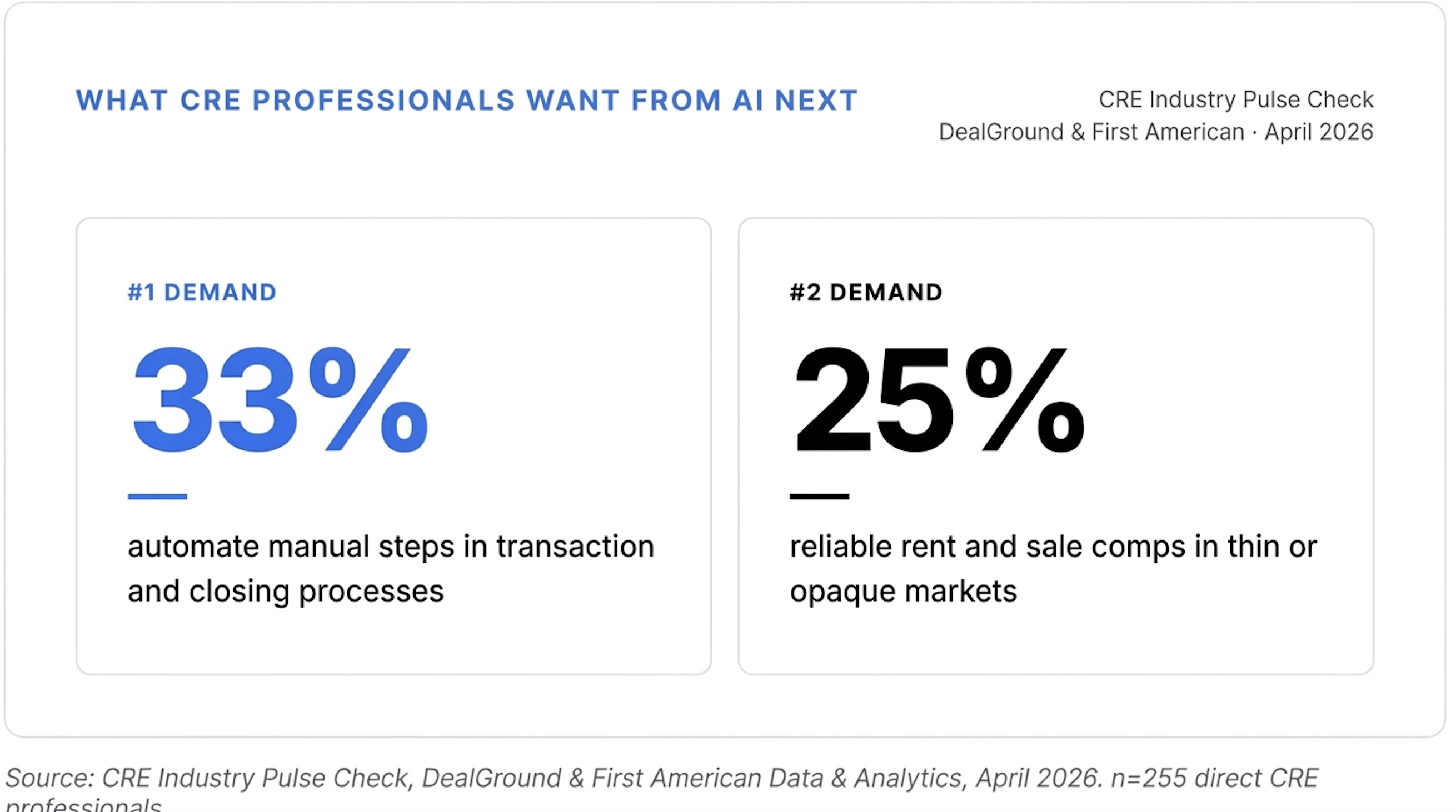
Both come down to the same thing: which tool, and what data is behind it. The demand covers the full transaction cycle, from finding the right owner, through pricing, negotiation, and closing. Every step has a data problem underneath it. Brokers don't need a generic AI searching the entire internet. They need AI that actually knows the market.
Every investment sales broker knows this one. You've identified a property. Ownership runs through an LLC, the kind of structure that turns simple outreach into days of searching public records, county assessors, and skip-trace tools. By the time you've found the right contact, someone else may already be in the conversation.
"In my 30 years as a broker, I don't even want to guess how many hours I spent chasing down data that turned out to be outdated, or tracking an owner that doesn’t want to be found only to hit a dead end," said Chris Rodriguez, Co-Founder of DealGround.
DealGround's automated ownership research converts complex ownership structures into contact information with transparent records showing exactly how each result was found. Teams report saving over 20 hours per week on ownership research. The call that used to happen in week three now happens within minutes. And once you've found the owner of a specific property, DealGround surfaces every other property they own, turning one lead into a full picture of their portfolio.
“DealGround is the solution I always wished I had: one place where brokers can find every record, every comp, every ownership trail, the moment they need to do a deal," said Chris, Co-Founder of DealGround.
Most comp searches in thin markets turn up the same handful of publicly available transactions: the ones that made it onto listing platforms, got reported, and left a public record. The most relevant deals are often the ones no one else can find. DealGround pulls from 160M+ title records and a running archive of historical offering memoranda, which means the comp set a broker walks into a meeting with includes transactions that weren’t reported or picked up by the legacy platforms. In markets where the data is thin, that's a major advantage.
The data is clear: the barrier isn't budget and it isn't accessible. It's trust. Brokers have tools. What they don't yet have is AI they'd stake a deal on.
We agree, and we're building accordingly.
In the coming weeks, DealGround users will be able to surface deal intelligence directly inside the AI assistants they already use – including Claude and ChatGPT. Brokers get the speed and convenience of using their preferred AI tool searching and analyzing the most current and complete CRE data. One question, one answer, no switching between tools.
CRE professionals are not resisting AI. They are doing exactly what good operators do with any new tool: pressure-testing it before they bet a client relationship on it.
The firms that figure out how to close that gap first – with workflow fit, reliable data, and AI that actually fits the way brokers work – will start winning deals others don't see coming. The data makes the case.
"The question of whether CRE professionals will use AI is settled. The next 18 months are about something harder: trusting AI enough to use it when the deal is actually on the line. The gap between the brokers that get there and the brokers that don't is going to be significant. The brokers who don't will find themselves a step behind. On the call, on the comp, on the close." — Dan Mosher, CEO of DealGround
Read the full CRE Industry Pulse Check report and the official press release here: http://report.dealground.com/cre-pulse-check-report-may-2026.