ResourcesTeamPricingContact sales

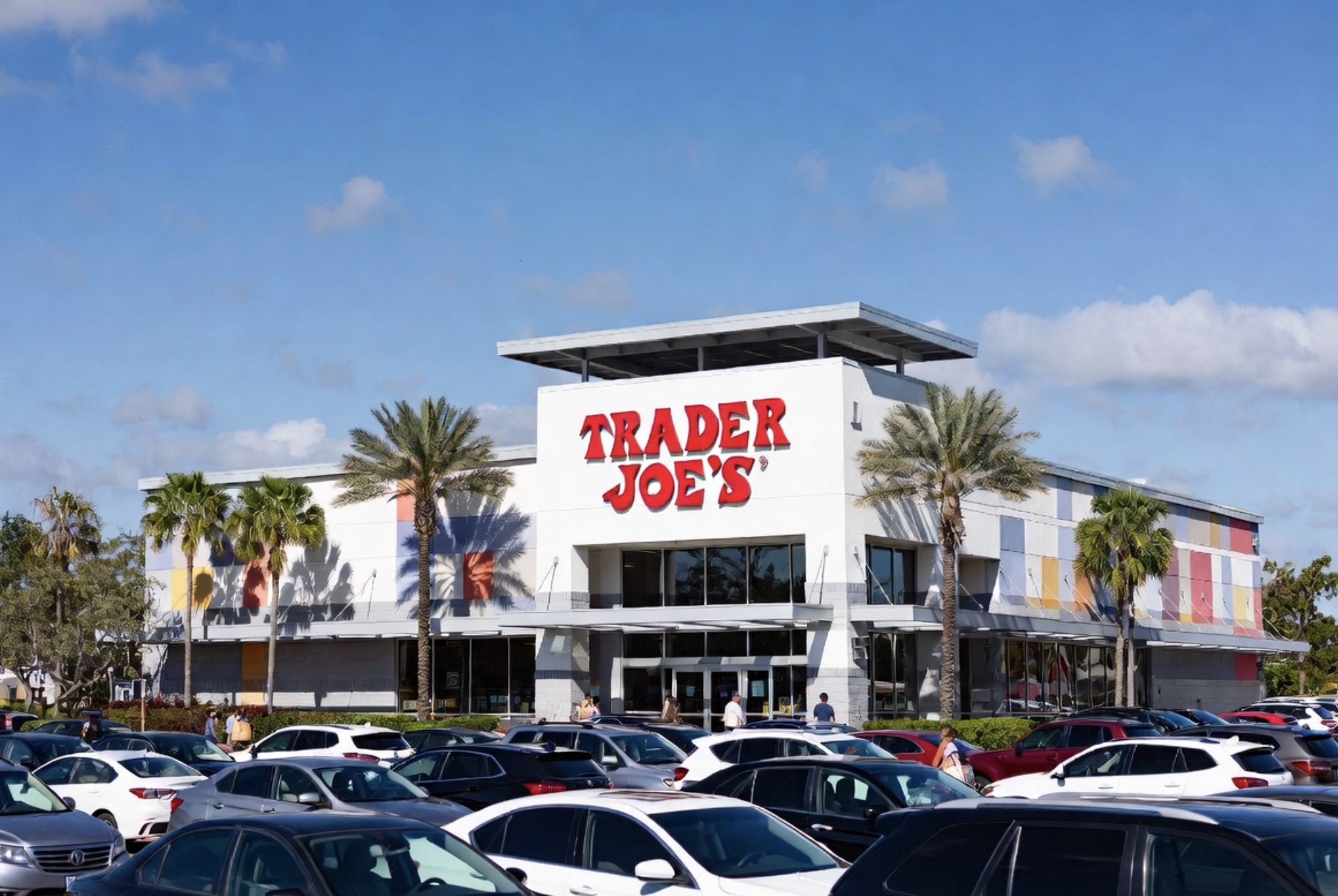
You already know what a Trader Joe’s does to a center.
You’ve seen the parking lot in the middle of the day on a random weekday. It is still moving. Not chaotic, just constant. You have probably had a deal where it came up, and everything is tightened. Pricing moved. Interest picked up. The whole tone of the deal changed.
None of that is new.
What is worth paying attention to is how they have managed to hold that position for this long without expanding the way every other grocery chain eventually does because they run it differently.
Take a quick step back.
Trader Joe’s started in Pasadena in the late 1960s. It was a small concept built around a very specific customer. Educated. Curious. Price-aware, but not chasing the cheapest option. That focus never changed.
Then in the late 1970s, the company was sold to Theo Albrecht, part of the family behind Aldi. That connection matters. If you have ever looked closely at Aldi, you know how tight that operation is. Limited SKUs. Private label. No waste.
Trader Joe’s took that discipline and layered a completely different front-end experience on top of it. The result is a unique combination. A highly efficient system behind the scenes and a very loyal customer base out front.
That is not easy to replicate.
Now look at the footprint.
Trader Joe’s has roughly 690 stores across the United States. That is a small number.
There are regional grocers with more locations than that, not to mention the national chains.
They could have doubled that count years ago. The demand is there. They chose not to. Instead, they stay selective. Very selective. They evaluate hundreds of neighborhoods and pass on most of them. When a site finally shows up publicly, the deal is already well underway. The site is secured. Permits are moving. The opening is usually only a few months away.
Their “coming soon” list is not marketing. It is a signal.
If you are working in that trade area, something is about to change. The store itself is where it starts to make sense.
Most Trader Joe’s locations fall somewhere in the 10,000 to 15,000 square foot range.
That is small for a grocery store. Inside that footprint, they are running around 4,000 SKUs. A typical grocer might carry 25,000 to 30,000.
Most of what they sell is their own product. That changes how people shop.
Customers are not wandering through long aisles comparing options. They move quickly. They get what they need. Then they come back again a few days later. That repeat pattern is what drives everything, and you see it in the numbers. Trader Joe’s is doing somewhere in the $2,000 to $2,400+ per square foot range, depending on the market. On a 12,000 to 15,000 square foot store, that puts annual volumes in the $25 million to $35+ million range. That is a lot of productivity in a relatively small box.
It also explains the parking lot. There are no real dead periods. The traffic is steady throughout the day. They also do not rely on the typical tools to drive that traffic.
There are no ads. No loyalty programs. No app pushing people back into the store. Even so, they ranked number one in the 2026 American Customer Satisfaction Index for grocery. That is ahead of Publix, H-E-B, and Costco.
What stands out is that this happened while they are still expanding. Most operators lose consistency when they grow. Trader Joe’s has not. The new stores behave like the existing ones. The same customer shows up. The same patterns hold.
From a real estate perspective, that consistency matters.
Florida is a good example of how they approach growth.
There are only 27 Trader Joe’s locations in the entire state. For a state of that size, that is limited. They have confirmed new stores in West Palm Beach, Sarasota, Kissimmee, and Maitland, with additional locations being evaluated.
When they open, the response is immediate. The Daytona Beach location drew roughly 700 people on opening day. Some customers were in line before 5:00 a.m. That kind of turnout is not typical for a grocery store. It reflects demand that was already there.
Arizona shows a different angle.
There is a noticeable amount of Trader Joe’s anchored product currently on the market across Phoenix, Tempe, Prescott, and Tucson. There are enough active deals to get a clear read on how the market is reacting.
What stands out is the range. Some assets are still trading with more room than you would expect for this tenant compared to tighter coastal markets. It feels like a pocket where pricing has not fully adjusted yet.
That kind of gap does not usually last.
When you zoom out, the pattern is consistent. Trader Joe’s deals trade differently.
Single-tenant assets tend to come in tighter than most grocery deals. That has held even as interest rates have moved. Multi-tenant centers anchored by Trader Joe’s also hold up better than comparable grocery-anchored centers.
There is a clear gap between Trader Joe’s deals and the rest of the grocery space. That gap is driven by consistency. Investors know what they are buying. They understand the traffic patterns. They understand the customer. They know the store performs without needing to be pushed.
That reliability is what gets priced in.
Any site Trader Joe’s selects is usually already a strong retail location.
The demographics are there. The corridor is established. The retail is already working. They are not fixing locations. They are adding to them. Once the store opens, activity increases across the entire area. Traffic grows. Visibility improves. More attention is drawn to the corridor.
Tenants take a closer look. Confidence in the location increases. Deals that were already solid become stronger.
The impact is not limited to one center. It extends across the surrounding pocket.
There are larger grocery chains. There are cheaper operators. There are many with more locations.
Trader Joe’s has taken a different approach. They have built a model around repeat customer behavior and have stayed disciplined in where they place it. That combination is difficult to replicate. And in real estate, it shows up in everything around them.
That is why deals around them are attractive.